This tale begins as all good tales do, in an alehouse. The alehouse to be precise, as Rota Lorden’s watering hole is the only one in Mordan. The only one in all the world. Besides, why would you need another when Rota’s ale, cider and whiskey taste like honey and soothe the nerves like nothing else?
We DMs all think we can Tolkien it up and make ham-fisted attempts at world building. I have, perhaps foolishly decided to put up one of mine here, to work it out here, and to keep the output of a higher standard than if I was hiding it away.

Winter is slowly melting into spring but the late snows cling to Mordan for a while longer and so the pub is crammed to the rafters. The fireplace is stoked into a frenzy and crude fiddles accompany even cruder songs. The drinks flow and Rota hefts another barrel from the cellar, her stout gnomish frame moving in strong, practiced motions up the groaning ladder. She wonders if her reserves will last the remaining few moons of winter, and the Scavvers that come with them, but she is not one to dwell on matters she cannot govern and continues scolding Berril, the young cook, before rejoining the gathering that is forming upstairs.
I’m imagining this as a campaign guide for a table-top game. Where the player characters (PCs) take on the roles of Mordanians who have been trained from childhood to be hardier and more cunning than everyone else, in order to take on the Scavvers each month. Ultimately the PCs would look to leave the valley in search of a new home for their people. What are Scavvers you ask? Well
Mordan’s brewmaster is of course not the only one whose mind wonders daily to the inexorable horror that accompanies every full moon, the Scavvening, or Scavvers as the little’uns call it; when the river turns red with rancid blood and the waters bring a plague of rats, bigger than dogs, that attack any in their path. They tumble down in the choppy water until they reach the ford around which Mordan is built and scatter throughout town. Their victims are left as nothing but unrecognisable piles of viscera, bone and cartilage and their hunger appears never to abate.
This is Mordan’s curse. This is why Mordan’s elders meet in Rota’s parlour this evening. This is why tonight they bring a small group of hardy young Mordans to their assembly.
How about a map?
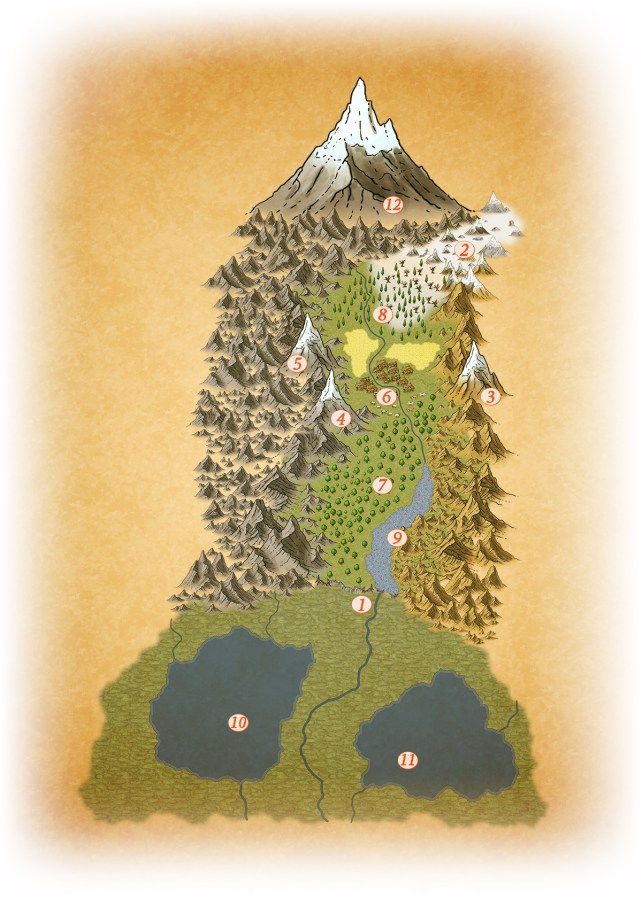
Mordan’s isolation is a simple geographical accident, the mile-high cliffs to the south (1), the icy waste to the north (2) and the seemingly endless mountain ranges flanking its east and west.
Of course a few have tried to scale the Drop (1) and brave the Howl (2) but none have ever returned. Some madmen have even tried to scale the endless ranges, heading west or east, contending steep escarpments and perilous ravines. They too have never returned. Bertra, the druid, from her roosts on the Brilling (3), the Vander (4) and the Colling (5), the great mountains that flank the valley, speaks of having seen wyverns, wolverines, even dragons that way.
Most in Mordan are content to see out their lives in the valley by the ford (6), the only trouble they see being the Scavvers that plague them every full moon. Myrtle Harrenforge, the town’s steadfast matriarch, however, grows worried. The town has grown larger than the valley can sustain; farmers complain of having nowhere else to plant crops and there is no good land for new homes. The forests on either side of the town, the southern Rushwood (7) and northern Winterfold (8), feature harsh, uneven, rocky terrain that is impossible to use for farming and unsuitable for housing.
The Rush (9) is a treacherous 10 mile stretch of rapids that has claimed the lives of many foolish or inebriated enough to brave it. The white waters reach a width of almost 2 miles as they reach the Drop (1), turning into a fine mist almost instantly, before mustering once again into a small, snaking river a mile below. This river flows between two great lakes, locally known as the Eyes of Orn (10 & 11).
Sitting atop it all is the Rhynefast (12), the great mountain, Mother of the Ranges. The highest pennant of cloud barely reaches halfway up her slopes and the highest third of the mountain is steep so as not to have any snow. Her peak is 20 miles at its highest and hides a great secret, says Bertra. Except perhaps on the most overcast days, Mordans always know true north because of her.
Cool right? Boy I hope you agree with me or have I horrendously misjudged this.
So the PCs have to choose which brand of death they’d prefer, falling, freezing, or the beasts to the east and west.
 johannes